

Legal Obstruction and Economic Antisemitism
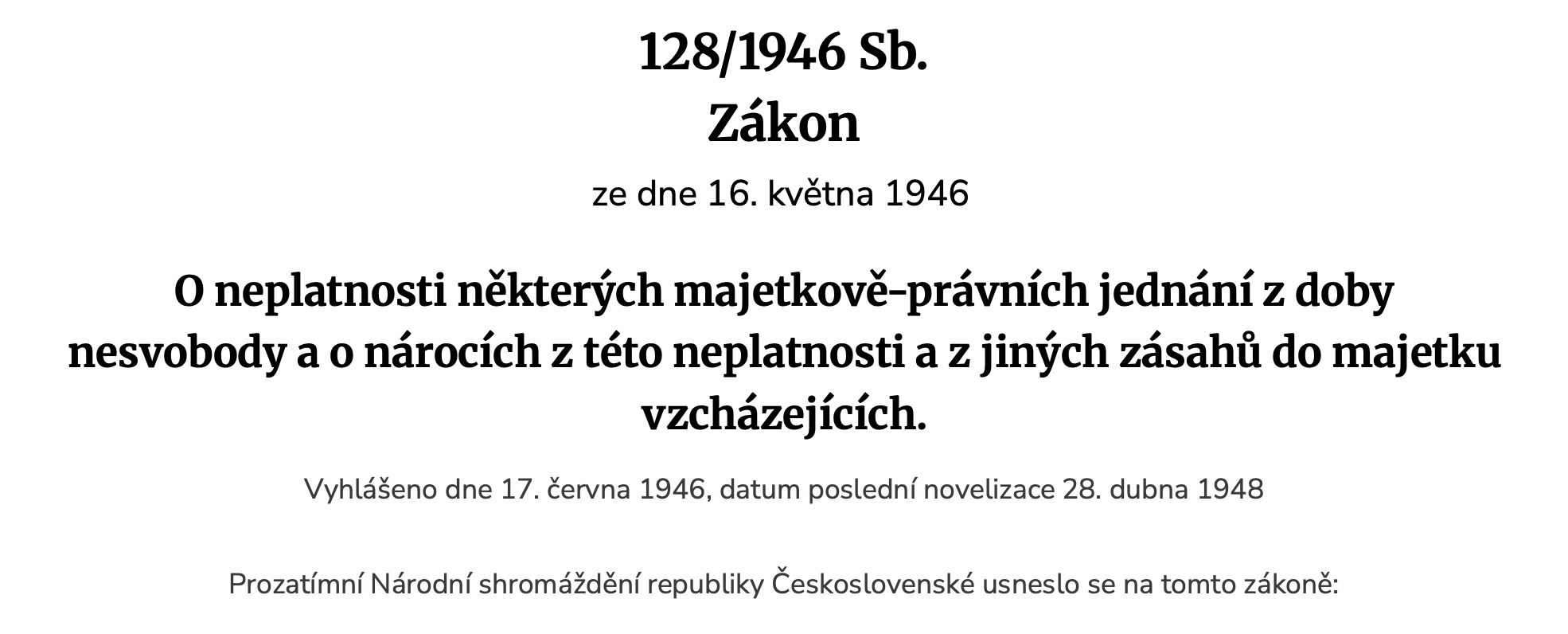
In May 1946, Czechoslovakia passed Act No. 128/1946, declaring all property transfers made under Nazi persecution invalid. Survivors sought return of homes, businesses, and land worth 4 billion Slovak crowns that had been Aryanized. Yet the Slovak government in Bratislava resisted implementation. Local property committees, often staffed by former partisans who profited from Aryanized businesses, blocked restitution claims. “With the exception of the Jewish community, there was overwhelming pressure not to implement the law.” In August 1946, frustrated partisans rioted in Bratislava, and the government responded by temporarily suspending restitution entirely. Without property, homes, or livelihoods, most Jewish survivors emigrated. This legal obstruction exposed how postwar antisemitism persisted through institutional failure and economic self-interest.
„Despite intervention from the central government in Prague, the Slovak government in Bratislava was unwilling to approve or implement the restitution laws. Slovak authorities worried about social unrest that might result from returning property to Jews.“
Overview of Immovable Property Restitution/Compensation in Slovakia
Jewish Policy Research Institute (Archive), citing Anna Cichopek-Gajraj, Beyond Violence: Jewish Survivors in Poland and Slovakia, 1944-48 (Cambridge University Press, 2014), p. 111.
Further Reading / Sources
Beyond Violence: Jewish Survivors in Poland and Slovakia. 1944–48
Cichopek-Gajraj, Anna, 2014, Cambridge University Press
Aryanization” and “Corruption in the Process of Aryanization of Jewish Enterprise Property in the War-time Slovak Republic, 1939–1945
Forum Historiae, 2025
Overview of Immovable Property Restitution/Compensation in Slovakia
Jewish Policy Research Institute
Ústav pamäti národa (UPN) – Institute of National Memory Slovakia
Archival materials on postwar property disputes and restitution investigations