Antisemitism
in Czechia

Antisemitism in contemporary Czechia is generally less visible than in other parts of Central and Eastern Europe, yet it persists in indirect and adaptive forms. Rather than manifesting through organised movements or frequent physical attacks, antisemitism most often appears via online conspiracy theories, symbolic vandalism, historical trivialisation, and the circulation of global antisemitic narratives—particularly those linked to Israel, liberal democracy, or alleged “global elites.” Periodic vandalism of Jewish sites and spikes in online hate speech during international crises underscore the persistence of these patterns. While surveys indicate comparatively low levels of explicit antisemitic attitudes, weak enforcement mechanisms and widespread historical distancing allow coded antisemitic tropes to circulate with limited consequence.

In recent years, antisemitism has increasingly migrated to digital spaces, intersecting with anti-EU sentiment, COVID-19 disinformation, and narratives portraying Jews as agents of hidden power. While far-right actors rarely foreground antisemitism explicitly, its symbolic language—financial conspiracies, media manipulation, and moral corruption—remains embedded in populist discourse. Sporadic vandalism of cemeteries and memorials illustrates the endurance of antisemitic symbolism despite the absence of mass mobilisation.

Historical Foundations, Rupture, and Post-War Silencing

Jewish life in the lands of Bohemia and Moravia spans more than a millennium and gave rise to one of Europe’s most influential Jewish cultural centres, particularly in Prague; yet this long coexistence was repeatedly shaped by legal exclusion, social discrimination, and episodic violence that embedded antisemitism within social and political structures well before the twentieth century. The Nazi occupation of Czechoslovakia in 1939 constituted a decisive rupture: under the Protectorate of Bohemia and Moravia, Jews were systematically stripped of rights, dispossessed of property, deported, and murdered as part of Nazi racial policy. Theresienstadt (Terezín) functioned simultaneously as a transit ghetto to extermination camps and as a propaganda instrument designed to conceal genocide, while approximately 80,000 Jews from Bohemia and Moravia were killed—effectively erasing centuries of Jewish presence and creating a profound demographic and cultural vacuum.

After 1945, Jewish survivors returning from concentration camps or exile encountered bureaucratic obstruction, social indifference, and latent hostility, particularly in disputes over restitution and property recovery; although the Czech lands did not experience large-scale post-war pogroms, antisemitism persisted through resentment, pressures to assimilate, and moral discomfort surrounding survivor return. Following the communist takeover in 1948, Jewish persecution was absorbed into a universalised antifascist narrative that obscured Jewish specificity and local complicity, while state-led “anti-Zionist” campaigns—especially after 1967—reintroduced antisemitic stereotypes in ideological language. Holocaust memory was depoliticised and instrumentalised, leaving questions of responsibility, continuity, and accountability largely unresolved until after 1989, when democratic transition enabled renewed research, restitution frameworks, and Jewish cultural life, even as liberalisation also created space for conspiracy movements, far-right subcultures, and historical relativism.

Memory, Accountability, and Democratic Resilience

Engagement with antisemitism by malign actors is shaped less by overt hostility than by selective memory. Dominant narratives emphasise Czech victimhood under Nazism while marginalising discussions of collaboration, opportunism, and post-war exclusion. This imbalance allows antisemitism to persist as an abstract or external problem rather than a domestic responsibility.

Democratic resilience depends on more than commemoration. It requires consistent prosecution of antisemitic acts, recognition of antisemitism as a distinct form of hatred, and educational approaches linking historical persecution to contemporary democratic values. The small but symbolically significant Jewish community remains a litmus test: how Czech society responds to subtle, coded, or politically inconvenient antisemitism will continue to reflect the depth of its commitment to pluralism and historical accountability.

MISINFORMATION & DISINFORMATION

“Jews secretly control governments, banks, and the media.”

A classic conspiracy narrative reframed as “global elites” or “hidden networks,” often pushed through memes, influencer clips, and “follow the money” threads. Disinformation accounts stitch unrelated facts into a single plot, implying Jews as the coordinating force behind democracy, capitalism, migration, or “the EU.” It launders antisemitism through coded language

Read more

(“bankers,” “Soros,” “Rothschilds”), making it harder to moderate while keeping the same scapegoating logic.

“Zionists run a ‘shadow government’ and must be resisted.”

This extremist trope recasts democratic institutions as occupied by Jews, portraying violence as “self-defence.” It spreads in fringe forums and cross-platform repost chains, then re-enters mainstream spaces as ironic slang or “anti-globalist” content. Disinformation tactics include selective screenshots, fake “leaked” documents, and mislabelled symbols to imply secret

Read more

Jewish command structures—turning political anger into an antisemitic worldview.

“The Protocols’ prove the Jewish plan to dominate the world.”

A known antisemitic forgery entitled ‘The Protocols of the Elders of Zion’, which fuelled the rise of antisemitism in Nazi Germany and Imperial Russia, is often repackaged as “suppressed history,” circulated via PDFs, subtitled videos, and “thread” summaries. Disinformation communities claim censorship as proof of truth, then connect the text to modern events (wars, markets, pandemics).

Read more

The manipulation lies in presenting a fabricated document as documentary evidence, and in using its storyline as a template to interpret any crisis as Jewish orchestration.

“Jews serve Israel over their home country.”

This narrative frames Jewish civic participation as suspect, often triggered by Middle East escalations. It spreads through “security” talk, loyalty tests, and insinuations about dual passports or “foreign influence.” Misinformation filters include cherry-picked examples of individual Jewish voices, then generalising them to all Jews. The move is rhetorical: it turns ordinary pluralism into “betrayal,” legitimising exclusion from public life and harassment.

Holocaust denial and relativisation

Denial content – that the Holocaust is exaggerated, invented, or ‘just history wars’ – circulates via “debunking” videos, fake statistics, and misused archival images, often paired with claims that remembrance is a Jewish power tool. Disinformation techniques include quote-mining historians, mistranslating documents, and presenting fringe “research” as scholarly debate. Even when framed as “questions,”

Read more

the aim is to erode shared factual ground and normalise antisemitic hostility by delegitimising Jewish trauma.

Blood libel: “Jews harm children or traffic organs.”

A medieval trope is modernised into claims about kidnapping rings, organ theft, or ritual harm – now spread via sensational “warning” posts and manipulated photos. Disinformation accounts exploit moral panic mechanics: urgent language, anonymous “insiders,” and calls to “protect children.” Filtering narratives detach the accusation from Jews explicitly – naming “Zionists” or “globalists” – while keeping the same allegation of inherently murderous Jewish nature.

The ‘Israel are Nazis’ heuristic

This appears as political commentary but functions as disinformation when it acts as a shortcut for the scapegoating of Jewish people or collapses history into a provocation that denies Jewish self-understanding and erases Nazi genocide. It spreads through viral comparison images and sloganised moral equivalence, often during conflict spikes. The key mechanism is ‘frame hijacking’, using Holocaust language to delegitimise Jewish identity and community safety, not to analyse policy.

“Jews created or profit from crises to reshape society.”

A flexible conspiracy container: any socioeconomic shock – for example, COVID, wars, migration – becomes evidence of a Jewish plot. Disinformation channels remix real anxieties with fabricated causality and scapegoats. Common tactics include forged “plans,” fake charts, and misattributed quotes, then amplification by coordinated networks. The narrative survives fact-checks because it constantly mutates – swapping actors and slogans while preserving the core antisemitic blame.

EXPLORE THE HISTORY OF ANTISEMITISM IN Czechia

2004 – 2024

EU ACCESSION & MEMBERSHIP

Following the Czech Republic’s accession to the European Union in 2004, antisemitism continued to evolve within an increasingly interconnected and digitalised environment. While overt neo-Nazi mobilisation peaked in the late 2000s and early 2010s, this period was characterised by the adaptation and diversification of antisemitic expression, rather than its decline. Organised far-right networks became more sophisticated in their coordination, staging symbolic actions and demonstrations—often targeting Jewish spaces—while also maintaining transnational links with like-minded groups across Europe and beyond.

At the same time, antisemitism expanded beyond traditional neo-Nazi subcultures into new ideological and communicative spaces. Islamist extremist narratives, though limited in scale compared to Western Europe, appeared alongside far-right conspiracy frameworks, particularly in online environments. Across the 2010s and early 2020s, antisemitic discourse increasingly merged with reactions to contemporary crises—including migration, the COVID-19 pandemic, and the war in Ukraine—embedding older tropes within new political narratives. This period also saw a marked rise in online radicalisation, particularly among younger individuals, contributing to both the spread of antisemitic propaganda and the emergence of isolated or small-group plots involving violence. Despite law enforcement interventions, antisemitism persisted as a fluid and adaptive phenomenon, capable of shifting across ideological, social, and technological contexts.

1989 – 2004

DEMOCRATISATION & TRANSITION

The collapse of the communist regime in 1989 transformed the political and social landscape of the Czech Republic, removing state controls over expression while reintroducing pluralism into public life. Within this newly open environment, antisemitism re-emerged not as state policy, but as a fragmented and decentralised phenomenon, expressed through extremist subcultures, conspiracy-driven media, and sporadic acts of violence. While official state policy was broadly supportive of Jewish communities and diplomatic relations with Israel were restored, parts of society reacted negatively, drawing on older antisemitic tropes as well as newly imported ideological influences.

Throughout the 1990s, antisemitism was primarily carried by far-right networks and subcultural movements, particularly neo-Nazi skinhead groups, which combined historical references to the Nazi period with contemporary conspiracy narratives such as the so-called “Zionist Occupation Government.” This period saw the emergence of antisemitic print media, zines, and early online propaganda, alongside physical attacks on Jewish individuals, places of worship, and cemeteries. At the same time, antisemitic discourse became increasingly interconnected with other forms of hatred, particularly anti-Roma racism and narratives linked to the Israeli–Palestinian conflict. Although law enforcement and courts occasionally responded through prosecutions, the persistence of incidents demonstrated the continued presence of antisemitism as a latent but mobilisable element within parts of Czech society, adapting to new political freedoms and communication channels in the post-communist era.

1945 – 1989

AUTHORITARIANISM & SURVEILLANCE

The defeat of Nazism did not bring an end to antisemitism in the Czech lands. Jewish survivors returning after 1945 often encountered bureaucratic obstruction, social resentment, and renewed injustice, particularly in efforts to reclaim confiscated property. Although post-war decrees formally annulled Nazi-era dispossession, their implementation frequently favoured wartime occupants, while some officials accused Jews of collaboration to justify retention of property. Public incidents in the late 1940s—including antisemitic hostility at public events and the suicide of war veteran Ejsik Weiss following hostile political rhetoric—demonstrated that antisemitism persisted beneath the language of antifascist reconstruction, even in the immediate aftermath of genocide.

Following the communist takeover in 1948, antisemitism was reshaped rather than eliminated. Open hostility gave way to state-led “anti-Zionism,” which portrayed Jewish identity as politically suspect and aligned it with foreign influence. Zionist organisations were dissolved, Jewish citizens were monitored under long-term surveillance programmes, and antisemitic stereotypes surfaced in show trials, propaganda, and diplomatic conflicts, particularly after 1967. Anonymous threats, cemetery vandalism, and the emergence of neo-Nazi youth groups in the 1980s revealed how antisemitism endured both within state structures and on the social margins. By 1989, Jewish life in Czechia had been profoundly shaped by decades of silencing, suspicion, and selective memory—illustrating how antisemitism can persist through bureaucratic practice and ideological distortion even in a state that defined itself as antifascist.

1939 – 1945

WAR & GENOCIDE

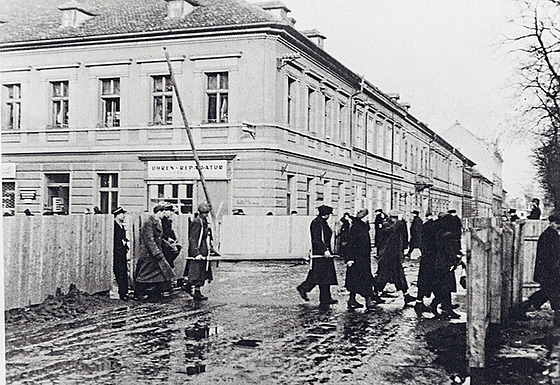
The Nazi occupation of Bohemia and Moravia in March 1939 brought the Jewish population under the full weight of German racial legislation. The newly created Protectorate became a laboratory for applying the Nuremberg Laws beyond Germany’s borders: Jews were stripped of citizenship rights, registered and marked, excluded from economic life, banned from public spaces, and subjected to escalating restrictions on movement, residence and livelihood. Aryanisation dispossessed tens of thousands, while “emigration” offices coerced families into surrendering assets before forcing them out. These measures, implemented jointly by German authorities and compliant Protectorate institutions, created a social environment in which antisemitism was normalised and Jewish presence treated as a problem to be managed, controlled and ultimately removed.

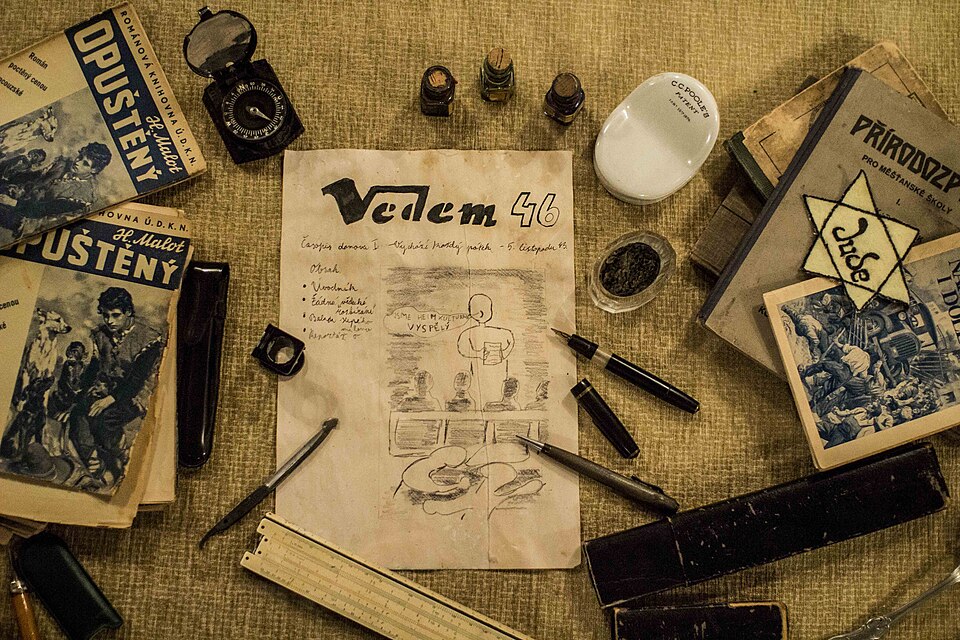
From late 1941, antisemitic policy transformed into organised annihilation. The first deportations to ghettos in Łódź and Minsk marked the shift to systematic removal. Theresienstadt—established as both ghetto and transit camp—became the central mechanism of Nazi persecution in the Czech lands, combining starvation, disease, and brutal overcrowding with constant onward transports to extermination sites. Tens of thousands died within Theresienstadt’s walls; tens of thousands more were deported to Auschwitz-Birkenau, including entire transports to the so-called Family Camp, liquidated in two mass killings in 1944. Even as genocide progressed, Theresienstadt was cynically used for propaganda, presenting a staged façade of “humane” treatment to international observers. In the war’s final months, evacuation transports, new deportations of Jews from mixed marriages, and a typhus epidemic deepened the suffering. When the Red Army liberated Theresienstadt on 8 May 1945, the Jewish communities of Bohemia and Moravia had been almost entirely destroyed—victims of a system that combined legal discrimination, economic plunder, forced segregation, and industrialised murder into a single, relentless programme of antisemitic persecution.

Explore the Full History

Dive deeper into key moments that shaped antisemitism and antigypsyism in Czechia.

View Czechia’s Timeline

Explore another country