

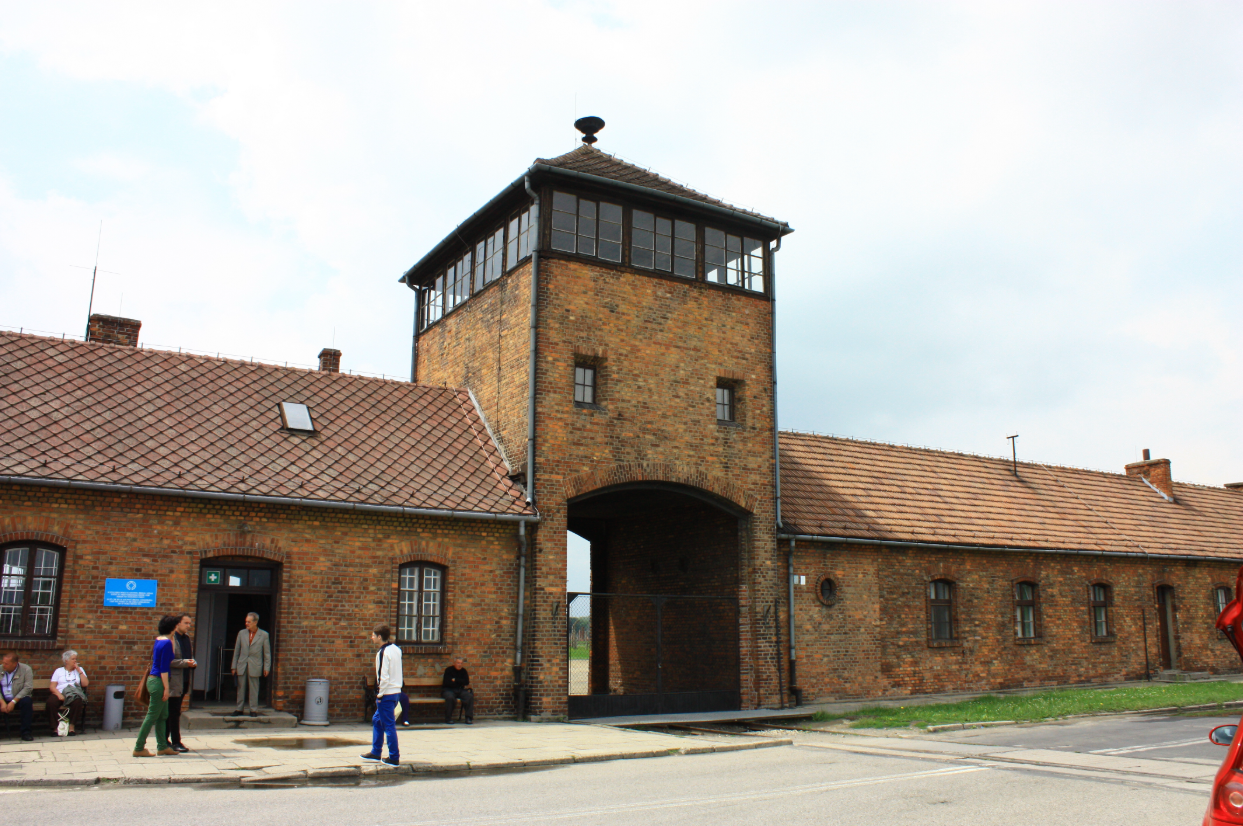

Far-right demonstration at a site of genocide provokes national outrage
On April 6, 1996, around one hundred members of the Polish National Community – Polish National Party (Polska Wspólnota Narodowa – Polskie Stronnictwo Narodowe), led by Bolesław Tejkowski, entered the grounds of the former Auschwitz-Birkenau camp. Many of the participants were neo-Nazi skinheads. The group claimed to be supporting the construction of a supermarket near the site, but the event quickly revealed itself as a political provocation with clear antisemitic undertones.
desecration of memory
The demonstration took place under the guise of defending Polish “economic rights” against supposed “foreign” influence, yet it was staged in a location symbolic of the Holocaust’s horror. The planned supermarket project by Polish private company, located within the protective zone of the former camp, had already faced opposition from Jewish organisations. Tejkowski’s entry with uniformed far-right militants was widely condemned as a desecration of memory.
Once a communist activist and later a nationalist opposition figure, Bolesław Tejkowski had reinvented himself after 1989 as a leading voice of antisemitism. His rhetoric fused anti-Zionism with conspiracy theories about Jewish power and German revisionism, echoing the propaganda of the 1968 campaign. The incident in Auschwitz highlighted how post-communist political pluralism allowed extremist groups to resurface and exploit historical wounds for ideological gain.
Further Reading / Sources
Brunatna Księga 1987–2009
Marcin Kornak, Warszawa: Stowarzyszenie „Nigdy Więcej” – 2009
Coverage on Tejkowski Rally
Jewish Telegraphic Agency Archives – April 1996