The spread of disinformation has amplified old myths of “Jewish control” and “foreign influence,” often under the guise of political or anti-Israel sentiment. Campaigns such as Stop 447 and online conspiracy theories surrounding COVID-19, the war in Gaza, and Western “globalism” reveal how antisemitic narratives adapt to new crises. Although open violence is less common, incidents of harassment, vandalism, and verbal abuse have increased, creating a climate of unease for Jewish communities, especially those involved in education, remembrance, and cultural life.
Czulent is a Polish organisation confronting antisemitism and hate speech in everyday life. It provides legal aid to victims of discrimination and works with police and prosecutors on systemic change that goes beyond individual cases. Their work also addresses how populism and disinformation polarise public debate, and why systematic monitoring of hate speech is essential today.
Historical Roots of Exclusion and Manipulation
The relationship between Poland and its Jewish community has been defined by centuries of coexistence punctuated by episodes of hostility. Before and during the Second World War, antisemitism took two dominant forms: economic resentment—promoting boycotts of Jewish shops—and the ideological myth of żydokomuna, which falsely associated Jews with communism. When Nazi Germany invaded in 1939, these attitudes were exploited to facilitate genocide. Pogroms in Podlasie, mass deportations under Aktion Reinhard, and the destruction of ghettos such as Warsaw, Łódź or Kraków revealed how Nazi occupation weaponised existing prejudice to isolate and annihilate Poland’s Jews.
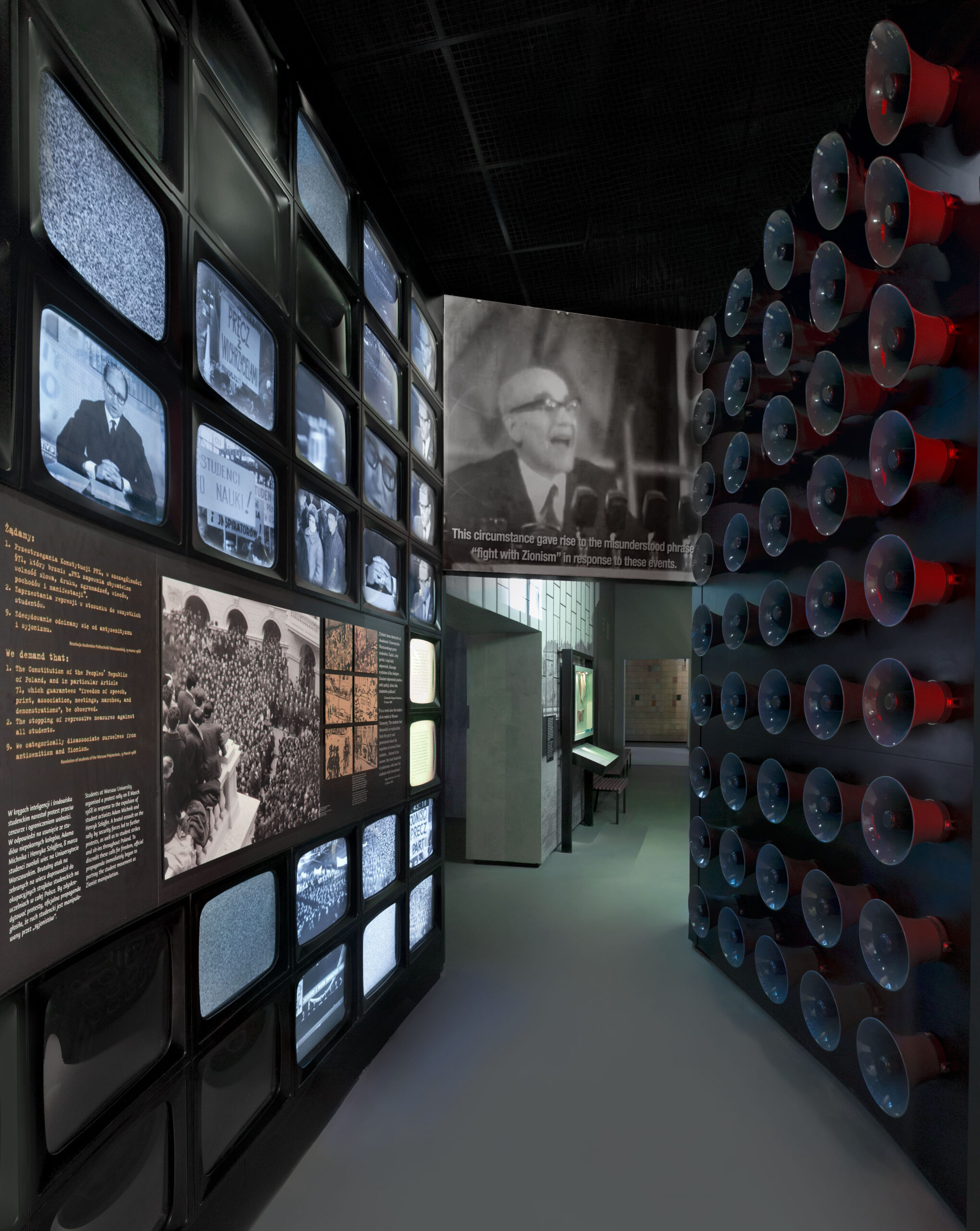
The war’s end did not erase antisemitism. Returning survivors faced hostility linked to property disputes and moral unease, culminating in violence such as the Kielce pogrom of 1946. In later decades, the communist regime manipulated antisemitism for political purposes—most notably during the “anti-Zionist” campaign of March 1968, when thousands of Jews were expelled from public life and forced into exile. These events cemented antisemitism as both a social prejudice and a political instrument, shaping the tone of public discourse well into the late 20th century.
Continuity Between Past and Present
Following the democratic transition of 1989, the liberalisation of public space allowed both honest reflection and renewed extremism. Antisemitic symbols and slogans appeared in football stadiums and public rallies, while some clerical and nationalist voices revived conspiratorial rhetoric about “Jewish influence” in politics or media. Debates about the wartime massacre in Jedwabne or Kielce pogrom revealed deep divisions within Polish collective memory—between efforts at truth-telling and reactions of denial or defensiveness. The 1990s also saw synagogue arson, vandalism, and street violence that exposed the enduring potency of prejudice beneath Poland’s democratic surface. Since joining the European Union in 2004, Poland has seen both progress and regression. Holocaust education and Jewish cultural renewal have expanded, yet antisemitism has adapted to the digital age. Hate speech, historical denial, and scapegoating flourish online, while acts such as the effigy burning in Wrocław (2015), the desecration of Jewish monuments, and attacks during commemorations demonstrate how old hatreds find new expression. Recent events—including the harassment of Jewish participants at Auschwitz remembrance in 2025 and death threats against family of tourists in Kraków—show that antisemitism continues to evolve with political moods and global crises. Confronting this continuum is therefore essential: Poland’s democratic maturity will be measured not only by remembrance of its Jewish past but by its courage to challenge prejudice in the present.