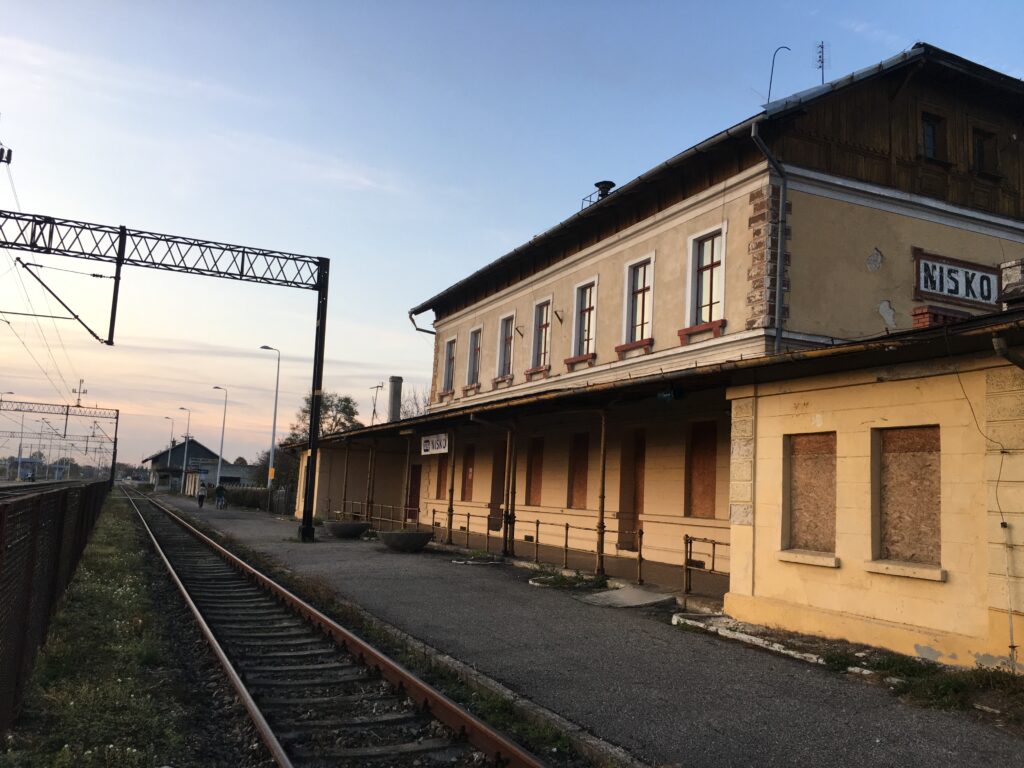
Source: The Theresienstadt Centre for Genocide Studies
Pilot deportations and the first attempt at mass relocation of Jews in occupied Europe
By the autumn of 1939, the Nazi occupation of Czechoslovakia had resulted in the swift imposition of anti-Jewish measures. Ostrava, an important industrial centre in the Moravian-Silesian region, was home to a vibrant Jewish community of approximately 10,000 individuals. Following the German annexation of the Sudetenland, Jewish residents experienced increasing marginalisation and loss of rights. During this period, the Nazi regime began exploring territorial solutions to the so-called “Jewish question”, including the Nisko Plan, an initiative promoted by Adolf Eichmann that aimed to forcibly relocate Jews to a remote area in southeastern Poland, near the town of Nisko upon San.
On 18 October 1939, approximately 1,000 Jewish people from Ostrava were gathered and deported by train to Nisko. The deportation was part of an early attempt to create a Jewish “reservoir” in the Lublin district of Nazi-occupied Poland. Conditions at the site were harsh and inadequately prepared; the men encountered an undeveloped area lacking in shelter, food, or sanitation. The absence of infrastructure, combined with exposure to the elements and disease, resulted in numerous deaths.
The deportation from Ostrava represented a significant precedent- it was the first organised mass deportation of Jews from Central Europe during the Holocaust. Survivors of the Nisko deportation were later subjected to further rounds of displacement, with many eventually perishing in ghettos, forced labour camps, or extermination centres such as Auschwitz. The deportation also marked an early stage in the career of Adolf Eichmann, who would go on to play a central role in the implementation of the Final Solution. For the Jewish community of Ostrava, the events of October 1939 constituted a devastating turning point, from which few would ultimately return. The episode remains a significant, though often overlooked, moment in the broader history of the Holocaust.
„The next day, the train stopped and the people had to get off. They stood in an open space—no sign of any village, accommodation, or shelter. Only then did they realize that this nothingness was Nisko.“
Ruth Elias, Hope helped me survive