

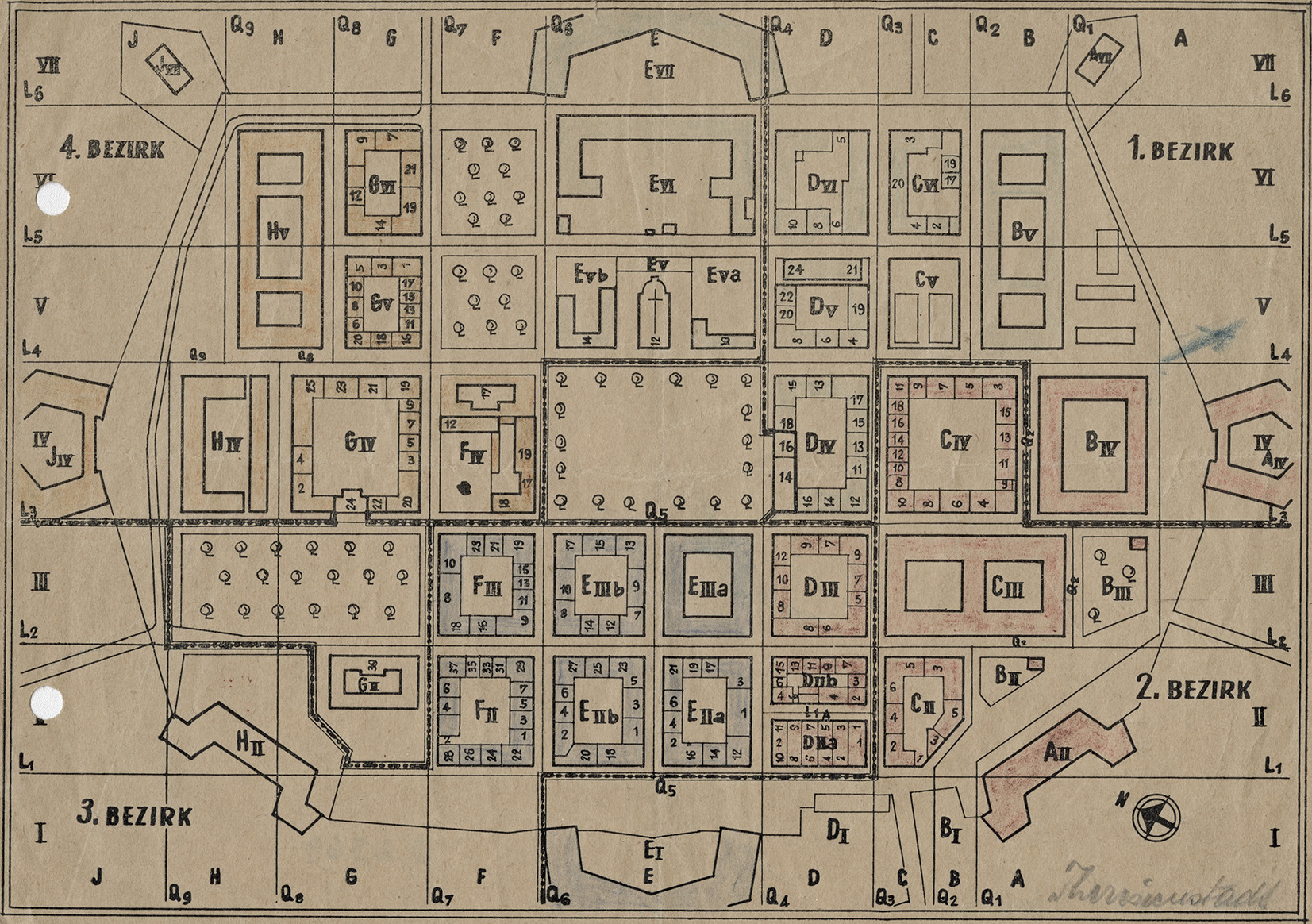
Jews from Bohemia and Moravia are segregated
In November 1941, the SS decided to set up a ghetto and transit camp for Protectorate Jews in the Main Fortress of Terezín, Theresienstadt in German. Theresienstadt was a fortress town built at the end of the 18th century by the Austro-Hungarian Empire, which at the time of World War II was located near the border with the German Reich and close to the railway line connecting Prague with Dresden and Berlin. The first group of Jewish prisoners arrived in Theresienstadt on 24 November 1941 from Prague from today’s Masaryk Railway Station (then Hibernerbahnhof) via the station in Bohušovice nad Ohří, approximately 3 kilometers from the Theresienstadt fortress. This group, the so-called Aufbaukommando, a construction commando of 342 men, was tasked with building the conditions for the arrival of up to 60,000 Jews in the Main Fortress of Theresienstadt.
The Czech inhabitants of the fortress town had to be forcibly evicted. The ghetto and the transit camp were strictly closed off from the surrounding area and guarded by Czech Protectorate gendarmes, stationed at Wieser’s house. The camp was managed by the SS Headquarters; organizational matters were handled by the Jewish self-administration. The Nazis used Terezín to serve four overlapping functions: transit camp, an advantage ghetto, a propaganda ghetto and as a camp for exchanging Jews.
By the end of 1942, the majority of the Jewish population, more than 61,000 men, women and children, had been deported to Theresienstadt from the Protectorate. Transports to Theresienstadt were dispatched until 1945. Transports were also sent from Germany, Austria, the Netherlands, Denmark and, at the end of the Second World War, from Slovakia and Hungary. In less than four years, more than 150,000 Jewish men, women and children from all over Central Europe passed through the Theresienstadt ghetto. About 34,000 Jewish men, women and children died in Theresienstadt, most of them elderly.
„More and more people were crammed into a small, ever-shrinking space, so that each person was constantly bumping into a rubbing up against everyone else; as intended, all manner of selfishness and greed blossomed, and all decency withered away.”
Leo Baeck, Rabbi, prisoner of the Theresienstadt ghetto and holocaust survivor
State Security (Stb), Information for the First Deputy Minister of the Interior of the Czechoslovak Socialist Republic. 1987
Further Reading / Sources
Videodocument „Terezín – druhá světová válka“
Anna HÁJKOVÁ, Poslední ghetto: Všední život v Terezíně, Praha 2021
The Last Ghetto, Oxford 2020
Hans Günther ADLER, Terezín 1941-1945: tvář nuceného společenství I-III, Praha 2006-2007
Theresienstadt 1941-1945: The Face of a Coerced Community
Hannelore BRENNER-WONSCHICK, Děvčata z pokoje 28, Praha 2011
The Girls of Room 28: Friendship, Hope, and Survival in Theresienstadt, Schocken 2009
Final Solution: The Fate of the Jews 1933–1949
David CESARANI, London 2016