

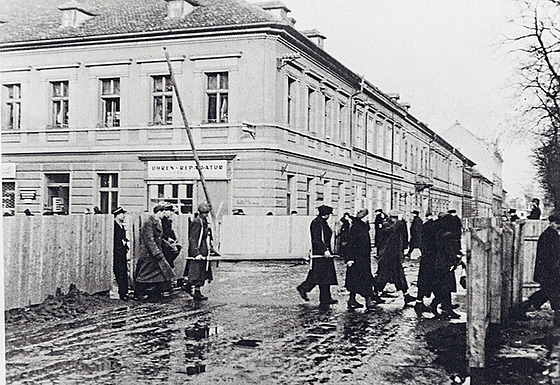
Jews from Theresienstadt are deported to death camps
From the beginning, Theresienstadt had a transit function – it was an assembly camp from which prisoners were deported to the ghettos and extermination camps in the East. The first such transport was publicly announced in the ghetto on 5 January 1942 (transport to Riga, today Latvia). The first thousand Jews from Theresienstadt were deported to Riga on 9 January. In 1942, the transports were mainly directed to Lublin, Izbica, Zamosc, and death camps in Maly Trostenets and Treblinka.
From the end of October 1942, transports from Theresienstadt were sent exclusively to the extermination camp at Auschwitz-Birkenau. The first of these, code-named By, left on October 26, 1942, with 1,866 prisoners. At the end of January 1943, an epidemic of typhoid fever broke out in Theresienstadt. Apparently out of fear of the epidemic spreading, the SS command stopped the transports for the next eight months. During this period, a railway siding was completed from the main line in Bohušovice nad Ohří directly to the Main Fortress in Theresienstadt – to the area of today’s Dlouhá Street. This solution was intended to speed up the deportation process and prevent contact between the deported groups of Jews and the civilian population in the vicinity of the Theresienstadt fortress. In September 1943, transports to Auschwitz were again dispatched with unprecedented intensity. The last transport to Auschwitz, code-named Ev, left Theresienstadt on October 28, 1944. A total of 87,000 prisoners from the Theresienstadt ghetto were deported eastward to concentration and extermination camps. Only four thousand of them survived World War II.
„We traveled for an extremely long time. I don’t know if it was cold or hot, but in any case, we were extremely thirsty and, of course, we drank everything immediately. The train stopped every few minutes, it was impossible to breathe, the whole journey seemed endless, perhaps it was two days and one night…”
Toman Brod, prisoner of the Theresienstadt ghetto and holocaust survivor
Further Reading / Sources
Videodocument „Terezín – druhá světová válka“
Anna HÁJKOVÁ, Poslední ghetto: Všední život v Terezíně, Praha 2021
The Last Ghetto, Oxford 2020
Hans Günther ADLER, Terezín 1941-1945: tvář nuceného společenství I-III, Praha 2006-2007
Theresienstadt 1941-1945: The Face of a Coerced Community
Hannelore BRENNER-WONSCHICK, Děvčata z pokoje 28, Praha 2011
The Girls of Room 28: Friendship, Hope, and Survival in Theresienstadt, Schocken 2009
Final Solution: The Fate of the Jews 1933–1949
David CESARANI, London 2016