

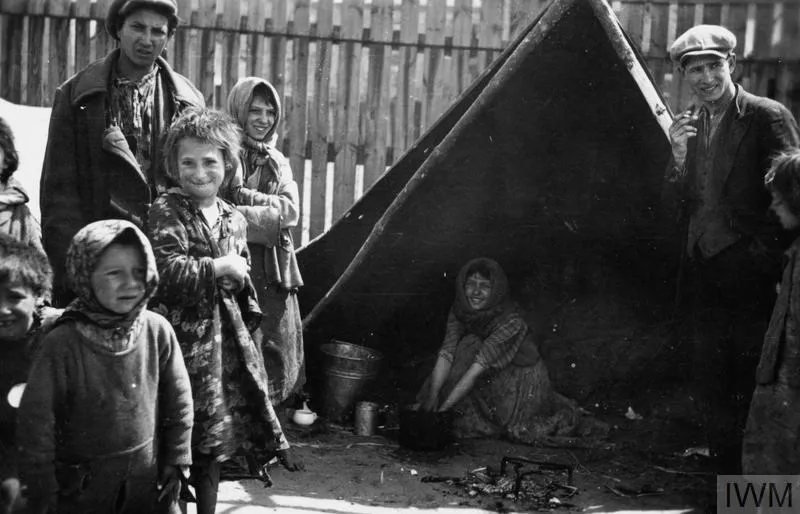
Labour as punishment, camps as control
The Slovak State imposed forced labour on Roma as part of racial and social policies aimed at control, segregation, and repression. Labeled “work‑shy” or “asocial,” Roma were placed under special regimes enabling detention in labour units and camps run by state and local authorities. Sites such as Dubnica nad Váhom and Ústie nad Oravou operated outside legal safeguards, where detainees endured exhausting labour, brutal supervision, and inadequate food, shelter, and medical care. Families were separated, and children were interned with adults, facing disease and abuse. This system reflected a racialised model of governance that treated Roma existence as a problem to be managed through coercion. Forced labour and camp structures functioned alongside antisemitic policies, showing how the Slovak State used interconnected mechanisms of persecution against minorities.
„In 1942 permanent Labour Crews for Gypsies and asocial persons were established … The labour camps became the main persecution tool of the anti-Roma policy in 1942–1944.“
THE ROMANI HOLOCAUST
Ústav pamäti národa (UPN)
Further Reading / Sources
Ústav pamäti národa – THE ROMANI HOLOCAUST
Brochure; main source on labour crews and camps 1942–1944
Roma and Sinti Genocide website – entry “DUBNICA NAD VÁHOM (SK)
Brief on Roma slave labour 1942–1944 and later transfer to detention camp
USHMM – Genocide of European Roma (Gypsies), 1939–1945
For general context on Roma forced labour and camps