Assimilation by decree
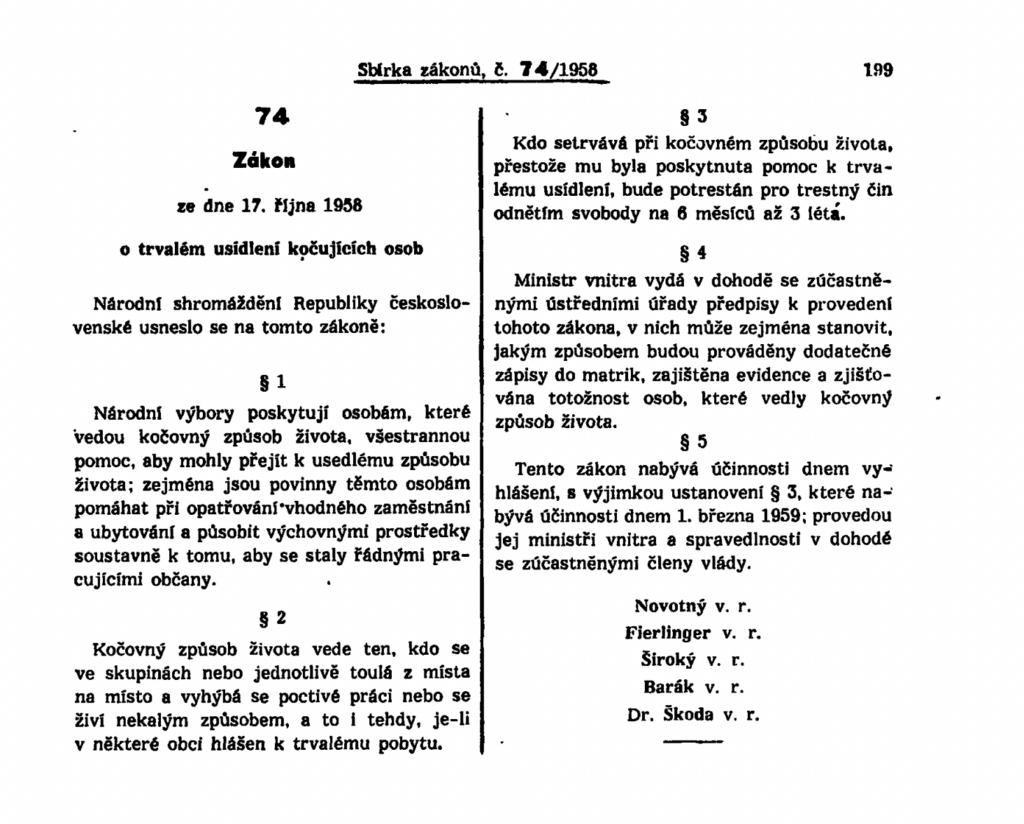
Law No.74/1958 marked a shift from postwar tolerance to compulsory assimilation. Though framed as regulating “nomadic persons,” it overwhelmingly targeted Roma, redefining mobility as deviant and empowering authorities to restrict movement, confiscate property, and impose compulsory residence and labour. From the 1960s to 1980s, Roma families were forcibly relocated, dispersed, or concentrated in settlements lacking basic infrastructure, with enforcement carried out by local officials, police, and social services. The law became a structural tool of antigypsyism, portraying Roma culture as a problem to be eliminated and enabling later segregation, spatial exclusion, forced labour, and intrusive state control over family life.
„Whoever persists in a nomadic way of life, despite having been provided assistance for permanent settlement, shall be punished for a criminal offense by imprisonment for six months to three years.“
Zákon č. 74/1958 Zb. o trvalom usídlení kočujúcich osôb
Further Reading / Sources
Slov-Lex – Official text of Zákon č. 74/1958 Zb. o trvalom usídlení kočujúcich osôb
Primary legal source, Slovak
Romea.cz – “65 years ago, Czechoslovakia banned life on the road: Did the communists destroy Romani culture?“
Detailed analysis of Law 74/1958, its enforcement, and long-term impacts
Romea.cz – “February marks the 62nd anniversary of communist Czechoslovakia forcibly sedentarizing Romani people”
On the February 1959 “inventory” and enforcement of the law
Markéta Hajská (SAV) – “Forced settlement of Vlach Roma in Žatec and Louny in the late 1950s”
Microhistorical study on implementation of Law 74/1958 using oral history and archives